The year was 2005, and I was in my late teens, pursuing a Bachelor’s degree in engineering. For the previous couple of years, I had been staying with my friends in an apartment on the outskirts of Coimbatore, the city where I studied. Engineering was not easy because I was made to pursue it, not out of my desire. Most of my friends were the same, but they saw their life’s purpose in completing engineering and getting a job at an IT company, and there I was, a rebel who did not fit in, and yet tried my best.
I felt more alive reading a work of fiction rather than a heavy book on computers and electronics.
I felt more alive reading a work of fiction rather than a heavy book on computers and electronics. These books were so lengthy and filled with technical jargon, it felt they were only written to assuage the author’s knowledge ego rather than imparting something useful to the learner. Just my take — no offense intended.
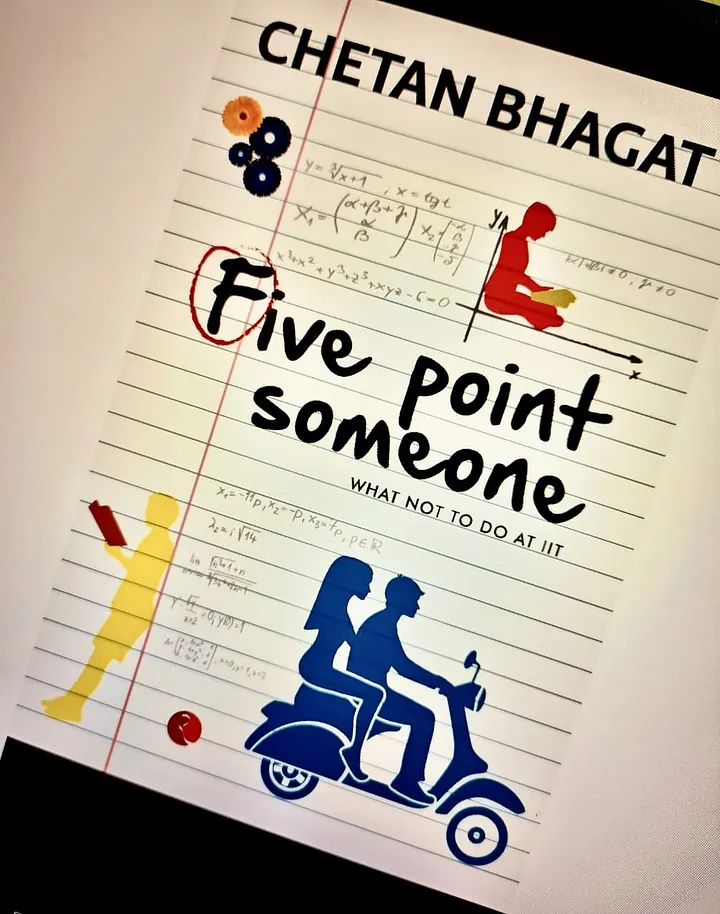
Around that time, a new novel that was released in 2004 began making waves among the fiction readers on campus. Some of us fiction readers usually exchanged books, and Five Point Someone by author Chetan Bhagat was seen carried by many. The book had caught the attention of most young readers, and around mid-2005, it reached mine as well.
I read the book and thoroughly enjoyed it. Especially, because it struck the right chords about the life of engineering students. The story stuck with us, and we began to bring it up often during our interactions. Slowly, a change began to manifest, and I believe it to be the reason the book became a phenomenon, a literary success.
Within a year, most people on campus had read his book, and mind you, this was the first novel by the author.
Until then, there were hardly a couple of people in a class of sixty who used to read fiction or other books for leisure. Suddenly, those who had no interest in reading fiction read 'Five Point Someone' and overnight became Chetan Bhagat fans. Within a year, most people on campus had read his book, and mind you, this was the first novel by the author.
Based on what I had observed several years ago, I list down a few reasons that, according to me, made it a huge literary success. I reiterate, what you read below is not based on any concrete research, but only my observation of the people who were around me during the time.
- Simple to read: Most of my friends during Engineering did not venture into fiction reading primarily because they had to refer to a dictionary several times, even for a single page. Within a few pages, they were usually confused whether they were reading the dictionary or the novel. But with this book, they felt it was easy to read and understand with minimal recourse to the dictionary.
- Easy to page: Most young readers saw themselves in the story. Well, of course, the story revolves around three engineering students, and in that year, almost half a million engineers passed out of Indian colleges. Don’t forget the almost 4x more students still pursuing in the lower classes. In addition, it is the first time that engineers were heroes in a fiction. Most engineers, current and past, were inevitably drawn to it, and with themes of love, exams, projects, and fun in a melting pot of emotional drama, many felt they were reflecting on their own story as they read.
- Hinglish yaar: Indians by design think differently, unlike someone who is Western or overly Western educated. The writing style followed by Western authors, and those following in their footsteps in India, is not within the realm of thought of an average Indian. Most Indians think with an emotional bent of mind and follow their native language structures in processing information. The usual English syntax doesn’t entirely resonate with the Indian psyche. A simple solution for this, mix English with a local language, and voila, it now makes sense to both the experienced and inexperienced Indian reader. Writer Chetan Bhagat championed this code, and his readers enjoyed it. In fact, it was natural for them, as it is how people normally conversed.
- Size matters: When compared to other hot-selling novels by Western authors, this book was less than 300 pages long. Not entirely small, but comparatively smaller for a first-time reader. It was simply a lesser mountain to scale than most other books that were in circulation among the reading tribe. It favorably seduced them into taking the first leap in venturing into something they had never tried — reading fiction.
- Word of mouth: Youth is all about the hype, the fad, and the fashion. Either by luck or sheer calculation, the book hit the sweet spot. Students who had never read fiction started yapping about it among their circles. Pretty soon, others who didn’t want to feel left out were hooked on it, and a chain reaction had started. Even in my college, one could easily see FOMO in action, and thanks to the insecurities of youth, it made the book even more popular. I noticed one senior who doesn’t like reading carrying it in his hands wherever he went, just to show off, of course.
- Non-English background: For a very tiny group of students, it was as simple as the joy of venturing into their first book in English. These were mostly from a non-English background who might have read fiction in their native language, but never any in English. Whether they read the entire novel or not, I’m uncertain, but each had a copy.
- Pocket change: Well, this is probably the most important factor among them all - Cost. The book was launched at Rs. 95 per piece in 2004, and at this price point, it was effectively within the purchasing power of most youngsters, a pocket change for many. When most authors sold at thrice this price, Rs. 95 made it all the more alluring to the young masses.
Ok, what good is any qualitative reflection without the supporting quantitative evidence? So here goes the stats. Since its launch in 2004, Five Point Someone has grossed over a million copies in sales by 2010. This is a phenomenal sales record for any Indian author, and such numbers were unprecedented in the Indian market for any single book.
The phenomenon called Five Point Someone helped many people break their shells on reading and turned them into lifelong readers.
These figures consistently repeated for all his later books, such as ‘One Night at the Call Center,’ ‘The 3 Mistakes of My Life,’ ‘2 States,’ and ‘Revolution 2020.’ By 2014, a decade since his first launch, Chetan Bhagat’s books had collectively sold over 7 million copies. Mind you, these are just numbers, which are publicly available estimates, not confirmed figures, which are likely to be on the higher side. But these numbers prove why Five Point Someone is considered a phenomenon.
The Five Point Someone phenomenon had helped many people break their shells on reading and turned them into lifelong readers. Authors like Paulo Coelho and Sidney Sheldon became even more popular in my circles after this wave. The new readers still preferred books that were smaller and easier to conquer, and books that fit this profile made the cut. Eventually, the book created a new literary revolution in the Indian market, where new authors and new readers continue to sprout even to this day.
Lastly, I just came to know that author Chetan Bhagat is releasing his next novel titled ‘12 Years — My Messed-up Love Story’ on the 1st of Oct this year. This is exciting news for all his fans, and my best wishes to the author for a successful launch.
Do the above observations remind you of other novels that enjoyed massive success? What was special about it? Do drop an email and share your thoughts.
Stay connected for more insights and stories by following me on Instagram and Facebook.
Originally published on medium.com on Sept 12, 2025